
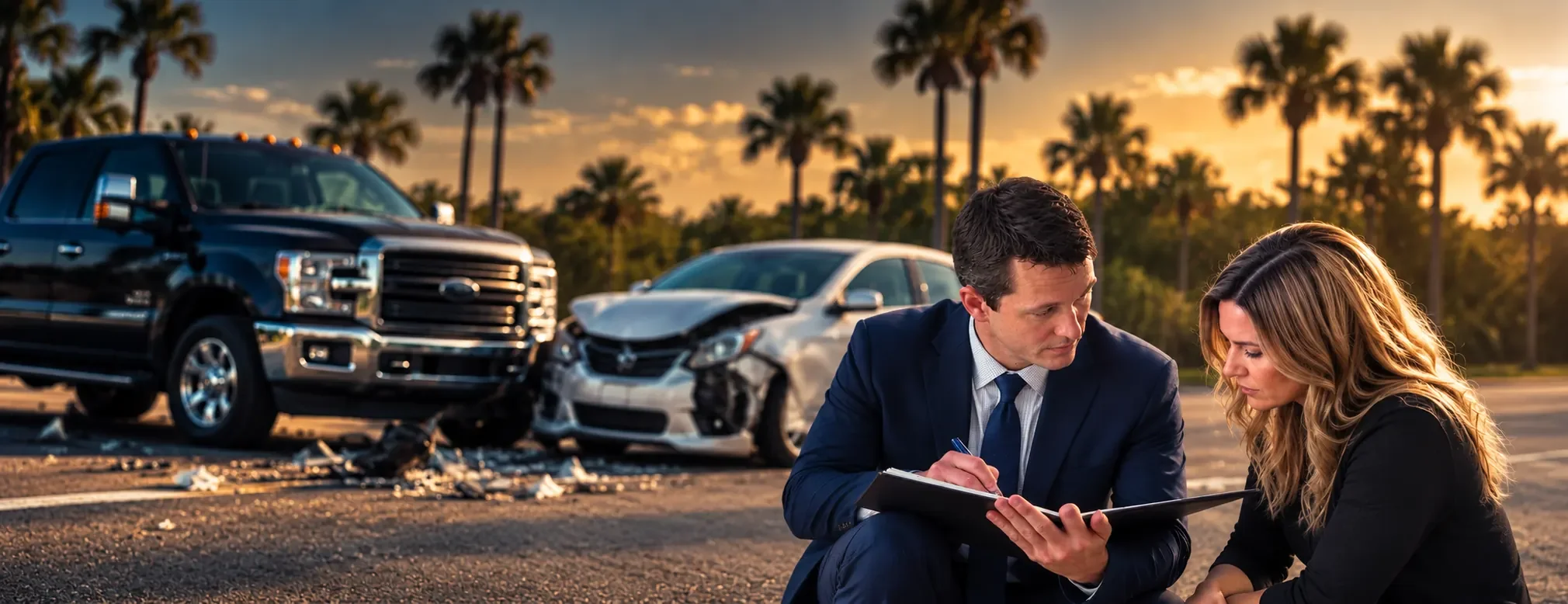
10 Things to Do After a Car Accident in Florida
What to Do at the Scene—and What to Avoid After You Leave
Updated October 2026 | By Logan T. Lawrence, Esq., Florida Personal Injury Attorney
After a car accident in Florida, your first priorities should be safety, medical attention, reporting the crash when required, exchanging information, and preserving evidence.
What you do in the first few minutes—and the days that follow—can affect your health, your insurance claim, and your ability to prove what happened.
As a Florida car accident lawyer, I have seen otherwise good claims become much more difficult because evidence was not preserved, an accident was not properly documented, or an injured person waited too long to address an important issue.
Here are 10 practical steps I recommend considering after a Florida car accident.
1. Get to a Safe Location and Check for Injuries
Your immediate concern should be safety—not the insurance claim.
Check yourself and your passengers for injuries. If anyone may be seriously injured, call 911 and request emergency medical assistance.
If the crash involves only property damage and the vehicles can safely be moved from the traveled portion of the roadway, Florida law addresses moving vehicles so they do not unnecessarily obstruct traffic. Moving a vehicle under those circumstances does not, by itself, make the person liable for causing the crash. Online Sunshine
Do not put yourself in additional danger trying to photograph vehicles, recover debris or inspect damage while standing in active traffic.
2. Call the Police and Report the Crash When Required
Calling law enforcement creates an opportunity for the accident to be documented while the drivers, vehicles and witnesses are still at the scene.
Florida law currently requires a driver to immediately report a crash involving injury or death, or apparent vehicle/property damage of at least $2,000. Online Sunshine
Even when you are unsure whether the statutory reporting threshold has been met, contacting law enforcement can be useful when:
Someone may be injured.
The vehicles have substantial damage.
The other driver disputes what happened.
The other driver appears impaired.
The other driver may leave the scene.
Insurance or identification information is questionable.
Do not rely solely on an agreement with the other driver to “handle it ourselves.”
I have seen cases where everyone appeared cooperative at the scene, only for the other driver's version of events to change later.
3. Photograph and Video the Accident Scene
If you can do so safely, use your phone to document the scene before important evidence disappears.
Take photographs or video of:
Both vehicles
Damage to each vehicle
License plates
The overall accident scene
Vehicle resting positions
Traffic signals and signs
Lane markings
Skid marks or debris
Nearby businesses or cameras
Road and weather conditions
Any visible injuries
Don't limit yourself to close-up photographs of vehicle damage.
Take several wider photographs showing where the vehicles are in relation to the roadway and surrounding landmarks.
Those images can sometimes tell a much more complete story about how the accident occurred.
4. Exchange Driver and Insurance Information
Florida law requires drivers involved in qualifying crashes to provide certain identifying information, including their name, address and vehicle registration number, and to exhibit a driver's license upon request if available. Online Sunshine
If it is safe to do so, collect or photograph:
Driver's name
Driver's license
License plate
Vehicle make and model
Vehicle owner
Insurance company
Policy number
Insurance card
Contact information
If the driver and registered owner are different people, document both.
That distinction can become important when determining which insurance policies and parties may be involved.
5. Identify Witnesses and Nearby Cameras
If someone witnessed the crash, obtain their name and contact information before they leave.
Don't assume the police report will contain every witness.
Also look around for potential video sources:
Businesses
Homes
Traffic cameras
Doorbell cameras
Dash cameras
Parking lots
Gas stations
Video evidence can disappear quickly because many systems automatically overwrite recordings.
For a disputed accident, identifying a camera immediately can be far more valuable than trying to locate footage weeks later.
6. Be Careful About What You Say at the Scene
Cooperate with law enforcement and provide the information required after a crash.
But avoid guessing about things you do not know.
Immediately after an accident, people can be shaken, confused or uncertain about exactly what happened.
You don't need to argue with the other driver about fault, and you shouldn't speculate about speeds, distances or events you didn't actually observe.
Stick to what you know.
Also remember that statements made to other drivers, witnesses, insurers or on social media may later become relevant to an insurance claim or lawsuit.
7. Get Medical Attention if You Are Injured
Some injuries are immediately obvious. Others may become more apparent after the initial shock and adrenaline of the accident subside.
If you believe you are injured, seek appropriate medical evaluation.
Florida's PIP statute also contains an important insurance deadline: to qualify for PIP medical benefits, an injured person generally must receive initial services and care within 14 days after the motor vehicle accident. Online Sunshine
That doesn't mean everyone involved in an accident should obtain unnecessary medical treatment.
It means that if you are injured, you should not ignore your symptoms and assume there is no consequence to waiting indefinitely.
8. Notify the Appropriate Insurance Company—but Be Careful With Statements and Documents
An automobile policy may require prompt notice of an accident.
Report the accident as required by your policy and provide necessary information.
However, understand which insurance company you are speaking with.
Your own insurer and the other driver's liability insurer do not necessarily have the same relationship or obligations to you.
Before giving a detailed recorded statement to another driver's insurance company, signing broad medical authorizations, or signing a settlement release, make sure you understand what is being requested and its consequences.
A settlement release can affect your ability to pursue additional compensation later.
9. Preserve Everything Related to the Accident
Create a folder—physical or electronic—and keep the important records together.
Preserve:
Photographs and videos
Crash information
Driver/witness information
Insurance correspondence
Claim numbers
Medical bills
Medical records
Prescription receipts
Towing/storage receipts
Repair estimates
Rental-car expenses
Wage-loss information
Also do not immediately dispose of a seriously damaged vehicle or other potentially important physical evidence if liability or the nature of the collision may be disputed.
In significant cases, preservation of physical and electronic evidence can become important.
10. Decide Whether You Need a Car Accident Lawyer
Not every Florida car accident requires an attorney.
A minor property-damage accident with no injuries and no meaningful dispute may be something you can handle yourself.
You should consider speaking with an attorney when:
You suffered significant injuries.
You require ongoing medical treatment.
Fault is disputed.
The insurance company denies the claim.
The insurer is pressuring you to settle.
You lost income.
A commercial vehicle is involved.
Multiple parties may be responsible.
The other driver has inadequate insurance.
You may have an uninsured/underinsured motorist claim.
A serious or permanent injury is involved.
The purpose of speaking with a lawyer shouldn't simply be to “have a lawyer.”
The question is whether legal representation can meaningfully help identify coverage, preserve evidence, establish liability, document damages and protect your interests.
What Should You NOT Do After a Florida Car Accident?
After an accident, avoid:
Leaving the scene when the law requires you to remain.
Putting yourself in danger to photograph evidence.
Arguing with the other driver.
Guessing about facts you don't know.
Posting details about your injuries or claim on social media.
Ignoring significant symptoms.
Assuming the other driver will voluntarily pay.
Signing a release you don't understand.
Discarding important photographs, documents or evidence.
How Long Do I Have to File a Car Accident Lawsuit in Florida?
For accidents governed by current Florida law, an action founded on negligence generally has a two-year limitations period under Florida Statute §95.11. Wrongful-death actions also generally have a two-year limitations period. Different claims and circumstances can have different deadlines, so the applicable limitation period should be evaluated for the specific case. Online Sunshine
My Perspective as a Florida Car Accident Lawyer
Some of the most avoidable problems I encounter in accident cases happen during the first few days.
A client may have a legitimate injury, but nobody photographed the vehicles. A witness disappeared without anyone obtaining a phone number. A nearby business had surveillance video, but nobody requested it before it was overwritten or everyone agreed at the scene about what happened, only for the other driver's story to change later.
You don't need to conduct a legal investigation on the side of the road.
But a few simple steps—protect yourself, report the accident when appropriate, document what you safely can, obtain identifying information, preserve evidence and address your injuries—can prevent significant problems later.
Florida Car Accident FAQs
Should I call the police after a minor car accident in Florida?
Florida law requires immediate reporting when a crash involves injury or death or apparent vehicle/property damage of at least $2,000. Even when you are uncertain whether the threshold is met, law-enforcement documentation can be useful when liability, identification or insurance is disputed. Online Sunshine
Should I move my car after an accident?
If a crash involves only property damage and a vehicle can safely be moved from the main traveled portion of the roadway, Florida law addresses moving it to avoid unnecessarily obstructing traffic. Moving it under those circumstances does not by itself establish fault. Online Sunshine
How long do I have to see a doctor after a Florida car accident?
For Florida PIP medical benefits, initial services and care generally must occur within 14 days of the accident. Online Sunshine
Should I take pictures after a car accident?
If you can safely do so, yes. Photographs of vehicle damage, license plates, vehicle positions, the roadway, signs, signals, debris and the surrounding scene may help document what occurred.
Should I give the other driver's insurance company a recorded statement?
Whether you should provide a statement depends on the circumstances and which insurer is requesting it. After a significant injury accident, consider obtaining legal advice before giving a detailed recorded statement to another driver's liability insurer.
Do I need a lawyer after a Florida car accident?
Not necessarily. Minor accidents without injuries or significant disputes may not require an attorney. Significant injuries, disputed liability, inadequate insurance, lost income or difficulty with an insurer are reasons to consider obtaining legal advice.
Injured in a Florida Car Accident?
If you were injured in a Florida car accident and have questions about what to do next, The Law Office of Logan T. Lawrence offers free consultations.
You can speak directly with a Florida personal injury attorney about the accident, available insurance coverage and whether hiring an attorney makes sense for your situation.
Call (352) 222-4460 for a free consultation.
About the Author
Logan T. Lawrence, Esq. is a Florida personal injury attorney and founder of The Law Office of Logan T. Lawrence. He represents people injured in car accidents and other personal injury matters throughout Florida and provides clients direct access to the attorney handling their case.
This article provides general information about Florida law and is not legal advice. Every accident and insurance claim is different.